RF Guru
PowerPole Power Supply HAT for Raspberry Pi Zero 12-24V
PowerPole Power Supply HAT for Raspberry Pi Zero 12-24V
Couldn't load pickup availability
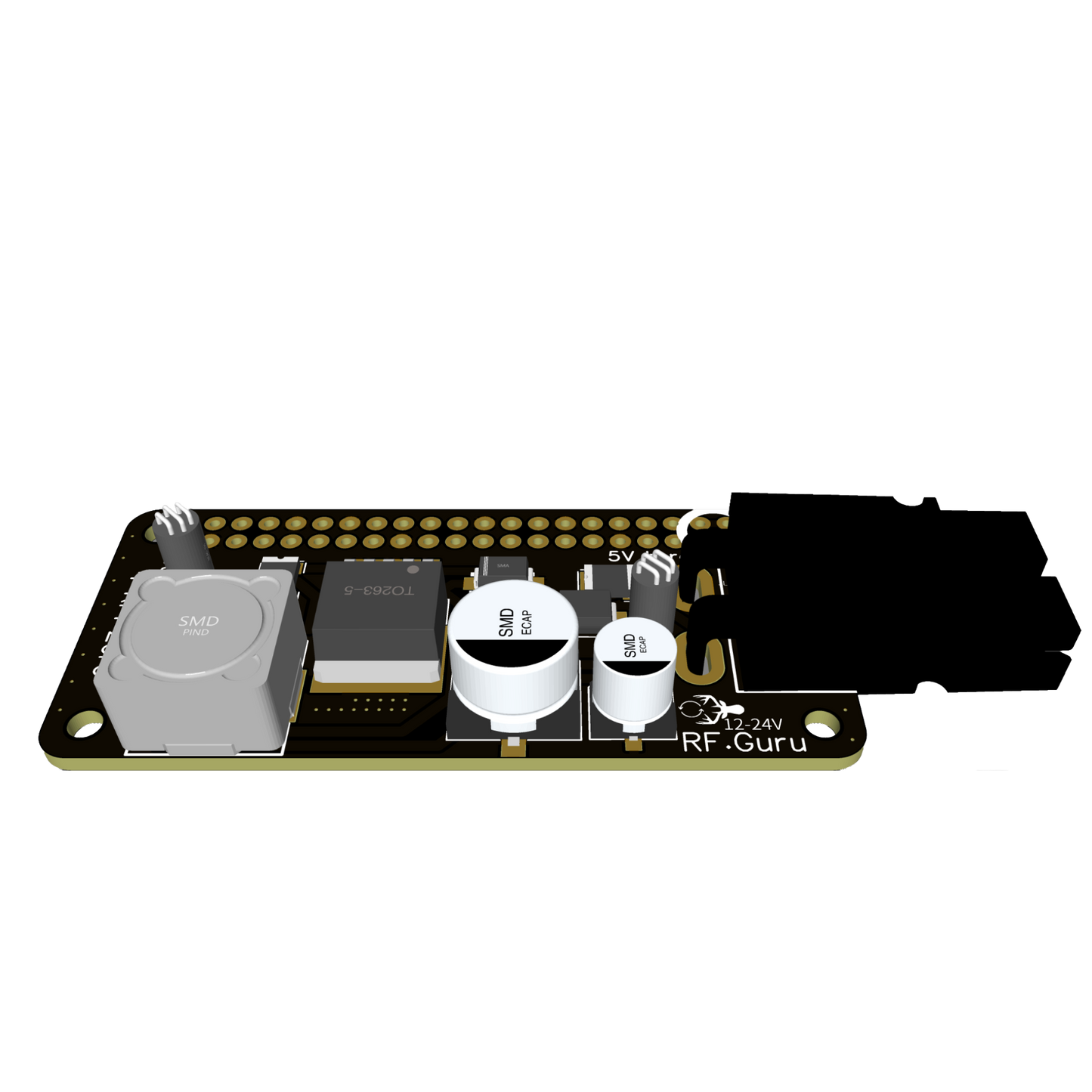
PowerPole Power Supply HAT for Raspberry Pi Zero
The downward-component Pi Zero package of RF.Guru's shared 12–24 V DC to nominal 5 V, 3 A PowerPole supply platform.
The four PowerPole products share the same conversion platform. Choose by Raspberry Pi footprint, component orientation, cooling arrangement or USB output—not by an invented difference in the nominal output rail.
Raspberry Pi Zero, Zero W, Zero WH and Zero 2 W package. Components face the Pi side of the stack; allow the required mechanical clearance.
Electrical identity: 12–24 V DC PowerPole input, one nominal 5 V DC output rail, up to 3 A. It is a single positive supply rail, not a split positive/negative supply.
Choose the Package, Keep the Power Boundary
| Product | Package | Interface distinction |
|---|---|---|
| 2023-P-811 | Full-size Pi HAT | Pi 3/4/5 package; fan options |
| 2021-P-052 | Pi Zero HAT | Upward-component package |
| 2021-P-053 | Pi Zero HAT | Downward-component package |
| USB supply | USB-output package | Additional conducted-noise filtering |
Power Path
Use one power path. Shut down the computer or load, remove station DC and disconnect USB power before fitting, removing or rewiring a HAT. Never assume PowerPole orientation from colour alone: verify source polarity at the connector before first power. Do not parallel the HAT output with the Pi's USB power input.
Raspberry Pi 5 Boundary
The 2023-P-811 package can supply the 5 V / 3 A mode used by Raspberry Pi 5, but Raspberry Pi documents that this mode limits downstream USB peripherals to 600 mA. The official 5 V / 5 A supply enables the larger USB budget. The bootloader's PSU_MAX_CURRENT setting declares the capability of a non-PD supply; it cannot turn a 3 A source into a 5 A source.
Check the complete load budget. Include the Pi, USB devices, fans and every GPIO accessory. Use an externally powered USB hub when the peripheral demand exceeds the Pi's available USB budget.
Development Measurements
The development plots report ripple below 15 mV peak-to-peak and radiated-emission traces below 10 dBµV peak in the described test setup. Those numbers are not a universal EMC certificate: load, grounding, cable routing, detector, bandwidth, fixture and ambient noise all matter.


Documentation and Noise Context
Package selection, safe first power, Raspberry Pi 5 limits and troubleshooting.
Separate conducted differential noise, common-mode current and radiated coupling.
Use controlled substitutions and current-path checks.
Current requirements and Pi 5 USB-peripheral limits.
Mini-FAQ
- Do all four products use the same supply platform? Yes. RF.Guru identifies them as packaging and interface variants of the same 12–24 V to nominal 5 V, 3 A PowerPole PSU platform.
- Does the output provide plus and minus 5 V? No. The family description means one nominal 5 V DC output rail, not a split ±5 V supply.
- Can I power a Raspberry Pi through the HAT and USB power input together? No. Use one intended power path and disconnect every source before fitting or removing the HAT.
- Does 3 A give a Raspberry Pi 5 full USB peripheral current? No. Raspberry Pi documents a 600 mA downstream USB limit when Pi 5 is powered from a compatible 3 A source.
- Does the word isolated mean safety galvanic isolation? No. On the USB package it describes additional RF/EMI path filtering; it is not a safety-isolated converter rating.