RF Guru
Analog HotSpot - Transceiver VHF - UHF 500mW PI4/PI5 CE
Analog HotSpot - Transceiver VHF - UHF 500mW PI4/PI5 CE
Couldn't load pickup availability
Download CE Certificate (PDF)
Analog Hotspot Repository
Free Bluetooth Companion App
The SVXLink Hotspot Companion App is available as a free download for Windows, macOS, Linux, Android, iPhone, and iPad. It allows convenient Bluetooth control of your RF.Guru Analog HotSpot / Transceiver from your computer, phone, or tablet.
Download the Free Companion App
The companion app is optional. The hotspot can also be used directly with the supplied SVXLink image and standard configuration tools.Analog HotSpot - Transceiver - 4th Generation
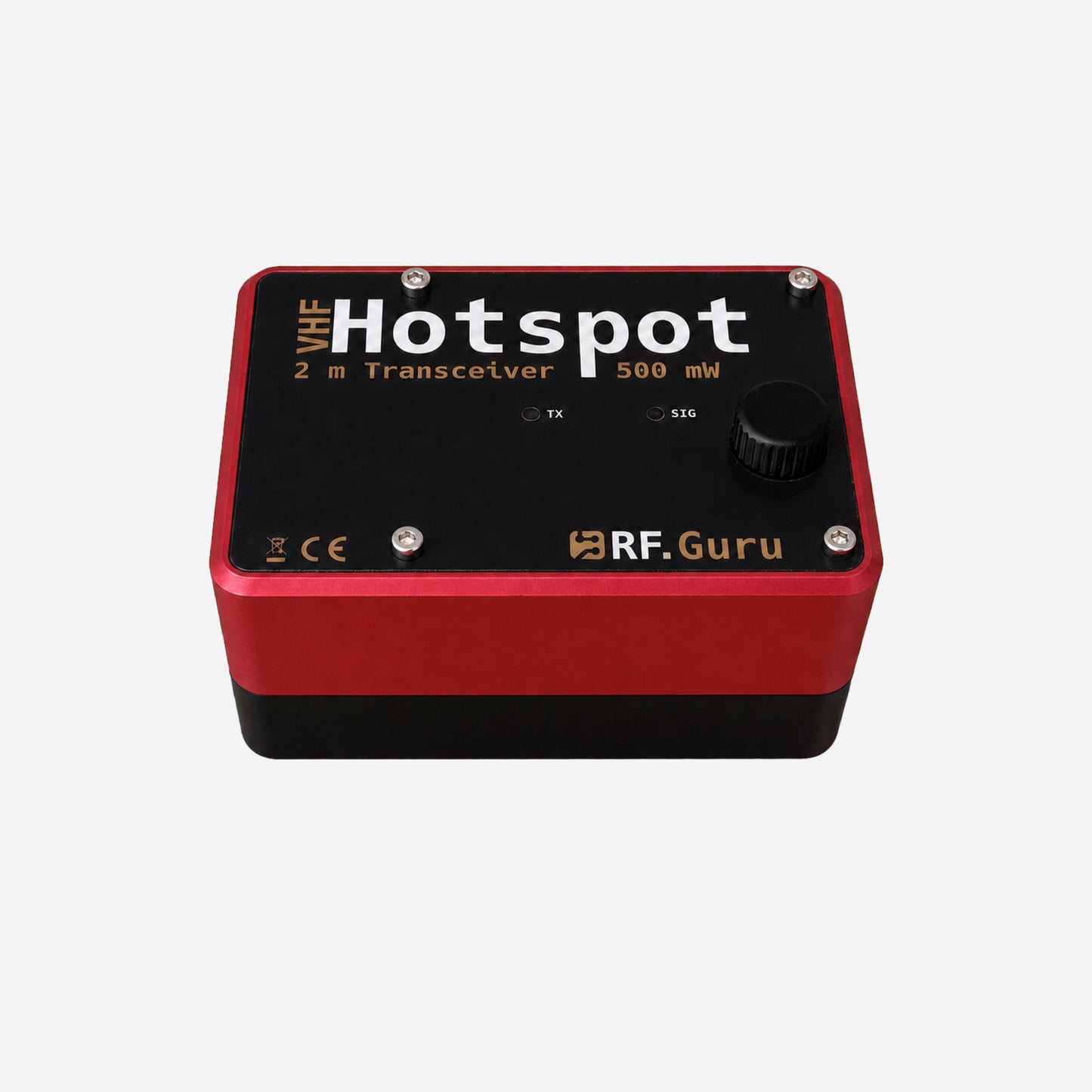
The Analog Transceiver/Hotspot is now in its 4th generation, featuring a redesigned power stage, improved filtering, and a more robust enclosure. We added additional DC-line filtering to eliminate noise sources, improved the thermal design with a durable plastic base and precision-machined aluminium top, added an even more capable internal thermal solution to the Pi 4 and Pi 5 editions, and increased the output power of both the UHF and VHF versions to 28 dBm (~500 mW). The included NoTenna2 attenuates the output to an EIRP of roughly 50 mW by absorbing most of the RF energy. If you need more range, you can simply connect an external antenna.
It is a compact and robust analog communications hotspot built around a Raspberry Pi. Choose the Raspberry Pi 4 edition (1 GB RAM) or the Raspberry Pi 5 edition (1 GB RAM), then select either the UHF 70 cm version (400–480 MHz) or the VHF 2 m version (134–174 MHz). Thanks to its Wolfson WM8960 DAC/ADC, it runs flawlessly as an EchoLink / SVXLink analog hotspot.
* Currently only an SVXLink Bookworm image is available for SVXLink and EchoLink.
Why Choose a Raspberry Pi 4 or Pi 5 Hotspot?
- Faster and more responsive — the more powerful quad-core processor provides snappier everyday operation, faster updates, and more headroom for SVXLink, EchoLink, logging, monitoring, and other services. The Pi 5 offers the highest performance of the two editions.
- Four full-size USB ports — two USB 3.0 and two USB 2.0 ports make it easy to add storage, serial interfaces, or other compatible peripherals.
- Gigabit Ethernet port — use a fast, stable wired network connection when Wi-Fi is unavailable, congested, or simply not preferred.
- More room to expand — the additional processing power and connectivity make these editions a better foundation for future accessories and more advanced hotspot setups.
- Designed for sustained use — the upgraded internal thermal solution and precision-machined aluminium top help dissipate heat during continuous-duty operation.
What’s New in the 4th Generation
- Improved DC filtering — additional LC filtering stages drastically reduce noise and ripple on the power line.
- Enhanced thermal design — the Pi 4 and Pi 5 editions provide even better thermal performance than the Pi Zero 2 W hotspot, using an upgraded internal thermal solution with a precision aluminium top for efficient heat dissipation during continuous-duty operation.
- Reinforced RF chain — cleaner TX signal, improved stability, and excellent spurious suppression.
- Higher output power — both UHF and VHF deliver 28 dBm (~500 mW) for improved range and more reliable linking.
- Mechanically stronger hybrid housing — like our Pi Zero 2 W hotspot, both editions combine a durable plastic base with a precision aluminium top. The top includes a dedicated antenna aperture to allow Wi-Fi operation while maintaining overall shielding effectiveness.
- Free Bluetooth companion app — control and manage the hotspot from Windows, macOS, Linux, Android, iPhone, or iPad using the optional SVXLink Hotspot Companion App.
- Included NoTenna2 attenuates the output to an EIRP of roughly 50 mW by absorbing most of the RF energy. If you need more range, you can simply connect an external antenna.
Specs at a Glance
| Feature | Specification |
|---|---|
| Raspberry Pi Edition | Raspberry Pi 4 with 1 GB RAM Raspberry Pi 5 with 1 GB RAM |
| Enclosure and Thermal Design | Durable plastic base with a precision-machined aluminium top Upgraded internal thermal solution on both editions |
| Frequency Range | UHF: 400–480 MHz VHF: 134–174 MHz |
| Output Power | UHF: 28 dBm (~500 mW) VHF: 28 dBm (~500 mW) |
| RX Sensitivity | UHF: −124 dBm @ 12 dB SINAD VHF: −104 dBm @ 12 dB SINAD |
| Bandwidth | 12.5 kHz / 25 kHz |
| Clock Stability | 1 ppm KDS TCXO |
| Audio Codec | Wolfson WM8960 ADC / 1 W DAC (48 kHz) |
| Bluetooth Companion App | Free download for Windows, macOS, Linux, Android, iPhone, and iPad https://svxlink-hotspot.app/ |
| Compliance | CE Certified (UHF worst-case spurious −86.23 dBc) |
| Estimated Power Consumption | Pi Zero 2 W reference: ~400 mA RX / ~600 mA TX Pi 4: ~650 mA RX / ~850 mA TX Pi 5: ~850 mA RX / ~1.05 A TX |
Included with the Product
- Complete tested device in a hybrid enclosure with a durable plastic base and precision-machined aluminium top
- Preloaded SD card with our latest image
- A 2 W terminated indoor antenna (50 Ω)
- Free Bluetooth companion app for Windows, macOS, Linux, Android, iPhone, and iPad
Key Features
- ENIG-finished PCB (Electroless Nickel Immersion Gold)
- Independent TX/RX frequencies, CTCSS, CDCSS
- Adjustable RX/TX gain levels
- Status LEDs: Signal/Tone, TX/PTT
- Ultra-stable 1 ppm TCXO
- Bluetooth companion app support for Windows, macOS, Linux, Android, iPhone, and iPad
Estimated Power Consumption by Raspberry Pi Edition
- Receive: Pi Zero 2 W reference: ~400 mA (~2.0 W) · Pi 4: ~650 mA (~3.3 W) · Pi 5: ~850 mA (~4.3 W)
- Transmit: Pi Zero 2 W reference: ~600 mA (~3.0 W) · Pi 4: ~850 mA (~4.3 W) · Pi 5: ~1.05 A (~5.3 W)
UHF Version Measurements
All measurements in this section apply to the UHF version. VHF measurements follow in the section below.
Sensitivity Measurements
The 12 dB SINAD sensitivity was determined using a 1 kHz tone FM-modulated at a 2.5 kHz deviation and injected into the receiver. This provides an accurate representation of real-world listening performance, fully aligned with industry-standard SINAD measurement procedures.
Compliance Measurements
All tests conducted with a calibrated Vector Network Analyzer (VNA) and 36 dB attenuator. Worst-case harmonic: −63.56 dBc (3rd), far surpassing ETSI EN 300 220 (≥43 dB below carrier for ≤30 dBm TX). This offers an extra safety margin of >20 dB. Spectrum confirms excellent spurious suppression and clean transmission inside the 12.5 kHz channel.
Compared with top brands like Kenwood, Icom, and Yaesu, our module demonstrates superior spectral purity, placing it on par with commercial-grade equipment.
Spectrum

Harmonics

Channel Power

VHF Version Measurements
Sensitivity Measurements
The 12 dB SINAD sensitivity was determined using a 1 kHz tone FM-modulated at a 2.5 kHz deviation and injected into the receiver. This provides an accurate representation of real-world listening performance.
Compliance Measurements
All measurements conducted with a calibrated Vector Network Analyzer (VNA) and 36 dB attenuator. Worst-case harmonic: −53.07 dBc (2nd harmonic), comfortably exceeding ETSI EN 300 220 CE RED requirements. This provides an extra safety margin of over 10 dB.
The spectrum confirms excellent spurious emission suppression and clean transmission within 12.5 kHz bandwidth. Compared to leading brands (Kenwood, Icom, Yaesu), our module delivers equal or superior spectral purity, placing it in the same performance league as established commercial radios.
Measurements
Spectrum

Harmonics

Channel Power

Mini-FAQ
- Is it CE certified? — Yes. The hardware meets CE RED requirements and the certificate is available above.
- Which bands are supported? — UHF 70 cm (400–480 MHz) and VHF 2 m (134–174 MHz).
- Which Raspberry Pi editions are available? — Raspberry Pi 4 with 1 GB RAM and Raspberry Pi 5 with 1 GB RAM. Edition and memory availability may change depending on component supply.
- Can it act as a hotspot? — Yes. Fully compatible with EchoLink and SVXLink.
- Is there a companion app? — Yes. The free SVXLink Hotspot Companion App is available for Windows, macOS, Linux, Android, iPhone, and iPad at https://svxlink-hotspot.app/.
- Digital networks? — Via AnalogBridge (DVSwitch): BrandMeister, OpenDMR, Fusion, etc.
- Output power? — UHF and VHF: 28 dBm (~500 mW).
- Sensitivity? — UHF: −109 dBm / VHF: −104 dBm @ 12 dB SINAD.
- What antenna is included? — A terminated 50 Ω indoor miniature antenna. Complementary antennas are available below for extended coverage.