RF Guru
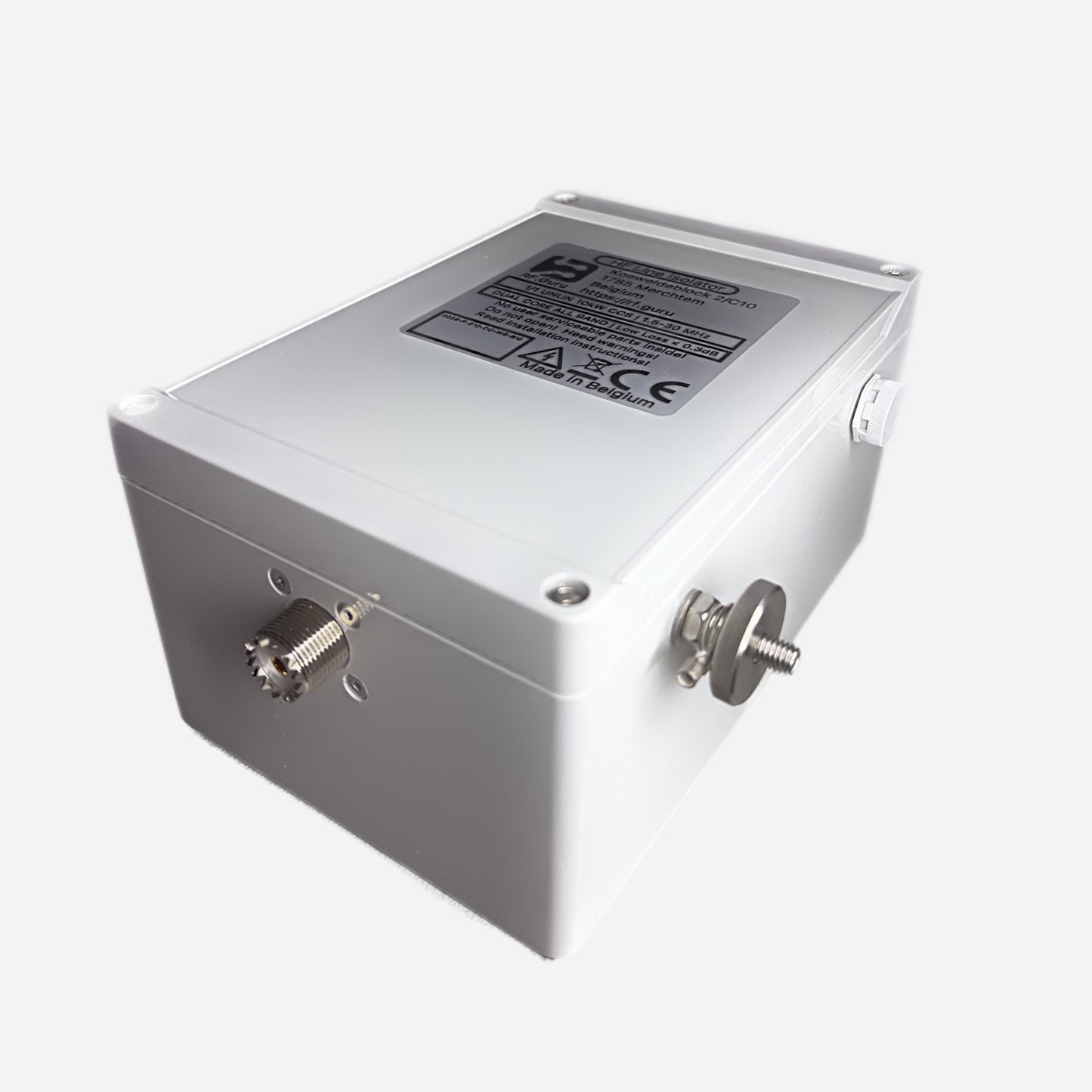
8kW High Power Six Core 4:1 UNUN 160/80M Band
8kW High Power Six Core 4:1 UNUN 160/80M Band
Couldn't load pickup availability
This is our high-power 4:1 voltage UNUN, available in two ICAS ratings and designed for serious HF QRO installations on 160–80 m, where voltage stress, thermal headroom, and mismatch tolerance matter more than idealized bench measurements.
This is a voltage transformer (autotransformer), not a current choke. Power ratings are governed by terminal voltage, current stress, and thermal rise under real antenna loads.
Baluns and UNUNs — What They Actually Do
Why Back-to-Back Transformer Tests Are Misleading
Available Versions
- 6 kW ICAS version: 4 stacked ferrite cores — compact, conservative QRO solution
- 8 kW ICAS version: 6 stacked ferrite cores — maximum thermal and voltage headroom
Specifications (common)
- Type: 4:1 voltage UNUN (autotransformer)
- Wire: High-temperature PTFE insulated conductors
- Optimized bands: 160 m and 80 m (40 m with reduced power)
- Enclosure: Ventilated, outdoor-rated polycarbonate
ICAS Power Rating vs SWR — 6 kW ICAS Version (4-core)
Conservative terminal-stress derating referenced to 6 kW ICAS @ SWR < 1.5 : 1.
| SWR | |Γ| | Worst-case V/I multiplier | ICAS Power Limit |
|---|---|---|---|
| < 1.5 : 1 | 0.200 | 1.200 | 6.0 kW |
| 2 : 1 | 0.333 | 1.333 | 4.9 kW |
| 3 : 1 | 0.500 | 1.500 | 3.8 kW |
| 4 : 1 | 0.600 | 1.600 | 3.4 kW |
| 5 : 1 | 0.667 | 1.667 | 3.1 kW |
| 6 : 1 | 0.714 | 1.714 | 2.9 kW |
ICAS Power Rating vs SWR — 8 kW ICAS Version (6-core)
Conservative terminal-stress derating referenced to 8 kW ICAS @ SWR < 1.5 : 1.
| SWR | |Γ| | Worst-case V/I multiplier | ICAS Power Limit |
|---|---|---|---|
| < 1.5 : 1 | 0.200 | 1.200 | 8.0 kW |
| 2 : 1 | 0.333 | 1.333 | 6.5 kW |
| 3 : 1 | 0.500 | 1.500 | 5.0 kW |
| 4 : 1 | 0.600 | 1.600 | 4.5 kW |
| 5 : 1 | 0.667 | 1.667 | 4.0 kW |
| 6 : 1 | 0.714 | 1.714 | 3.5 kW |
ICAS assumes intermittent amateur duty cycles (SSB / CW). Digital modes require additional derating.
Many RF components are advertised using PEP (Peak Envelope Power) numbers because they look impressive — but PEP alone says very little about whether a device will survive in real amateur radio use.
- PEP is an instantaneous peak value. It ignores heating, reactive currents, and voltage stress between peaks.
- Real antennas are not 50 Ω resistors. Impedance varies with band, height, ground, and environment.
- Losses are not linear. Ferrite heating and conductor losses rise with I²R and voltage stress.
- ICAS ratings account for duty cycle, thermal rise, and mismatch — making them representative of SSB and CW.
ICAS tells you what the hardware can actually survive — PEP often only tells you what looks good on a datasheet.
Mini-FAQ
-
Q: Which version should I choose?
— Use 6 kW ICAS for typical legal-limit stations; choose 8 kW ICAS for maximum headroom and mismatch tolerance. -
Q: Do I still need a choke?
— Yes. This UNUN transforms impedance; it does not suppress common-mode current. -
Q: Can I run CW at full power?
— Yes, with reasonable keying duty and SWR under control.
Interested in more technical content? Subscribe to our updates.
Questions or experiences to share? Contact RF.Guru.
Share