RF Guru
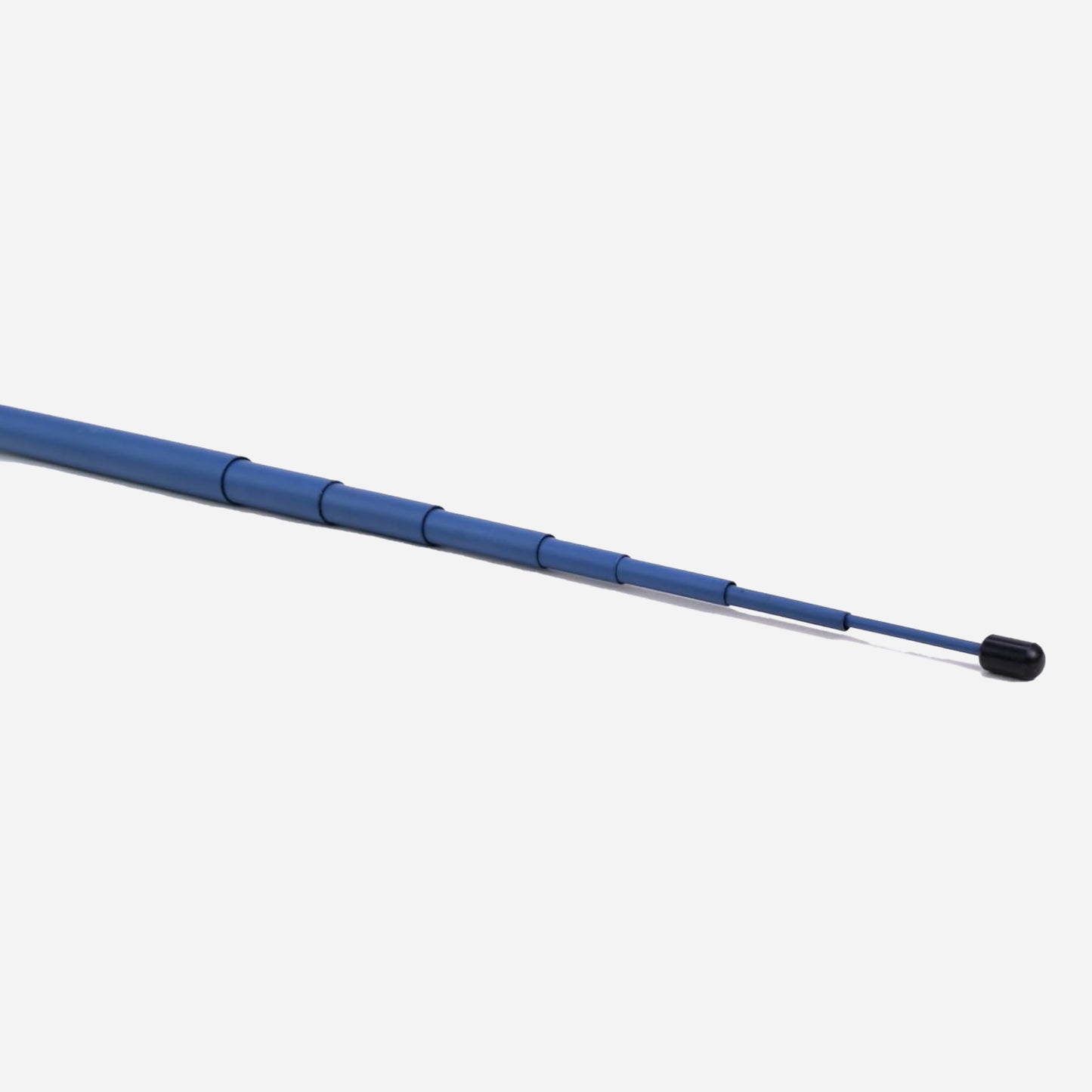
GRA-CF5200 5.12m Carbon-Fiber HF Whip (20m Band)
GRA-CF5200 5.12m Carbon-Fiber HF Whip (20m Band)
Couldn't load pickup availability
Updated December 2025
What Recent Resistance Measurements Tell Us About the 20 m Carbon Whip
Carbon Fiber Antenna Elements vs Stainless Steel
Carbon Fixed-Size Whips vs Stainless Slider Whips
Carbon Radiators — Miracle Antenna or Marketing Smoke?
The CF5200 is an ultra-light, extra-long 5.12 m carbon-fiber HF whip designed for maximum efficiency on the 20-meter band. At this length, it achieves near-ideal ¼-wave resonance at 14 MHz without requiring a loading coil — making it one of the cleanest and most efficient portable whips for 20 m operation.
Despite its length, it collapses down to just 64.5 cm for easy transport, and weighs only 190 g (214 g with adapter). This makes it extremely well-suited for backpack portable work, POTA/SOTA, expedition use, or lightweight mobile HF.
⚠️ Important Warning — This Is Not a Sliding Stainless Whip
This carbon whip must be used fully extended. It is not a stainless telescopic whip with sliding segments. Operating the whip partially extended can cause:
- mechanical binding
- structural damage
- RF arcing between segments
- premature wear or breakage
Always extend all 10 sections fully before transmitting.
Mechanical Design
The CF5200 uses 10 carbon-fiber sections in a stable telescopic configuration. Carbon provides exceptional stiffness, keeping the radiator straight with minimal sag — a major advantage over stainless whips at this length.
The base connector is M10-1.0P male, and a free M10-1.0P → 3/8-24 stainless adapter is included for compatibility with nearly all HF mounts.
Electrical Characteristics
At 5.12 m, the whip is long enough to reach quarter-wave resonance on 20 m with no coil. This significantly reduces resistive loading and loss, which is why long physical radiators outperform short stainless whips with heavy coils.
For 40 m, 60 m, and 80 m, the CF5200 can be paired with a loading coil. Thanks to its length, required inductance is modest, and efficiency is improved compared to shorter portable whips.
Feature Summary
- 5.12 m length — resonant on 20 m without a coil
- 10 carbon-fiber sections — light, stiff, and durable
- 64.5 cm collapsed — extremely portable
- M10 base + 3/8-24 adapter included
- Weight: 190 g (214 g with adapter)
- Maximum power: 250 W ICAS — 100 W DIGITAL/CW
- Compatible with loading coils for lower bands
- CF5200 5.12 m carbon-fiber whip
- M10-1.0P → 3/8-24 stainless adapter
- Protective carrying sleeve
Why Carbon Fiber?
Carbon fiber is surrounded by myths in the ham community. Our lab measurements show a clear, balanced reality:
- For long radiators (≥ 5 m), physical length dominates efficiency. The advantage of a full 5.12 m whip far exceeds the small conductivity difference between carbon and metal.
- Carbon’s resistive loss is measurable — but negligible in real operation. On 20 m, you will not see a difference in radiated signal compared to an equally long metal whip.
- Short stainless whips aren't inefficient because of the metal — they’re inefficient because they’re short. Loading coils introduce far more loss than carbon's RF resistance ever will.
-
Carbon has real mechanical advantages:
- stiffer → stays vertical
- lighter → supports longer radiators
- less sag → maintains full electrical length
For operators who want deeper insight, the related articles above explain carbon’s behavior in detail — without myths or marketing.
Recommended Use Cases
- POTA / SOTA lightweight deployments
- Backpack HF expeditions
- Portable verticals (with or without tuners)
- Mobile HF with proper support mounts
- High-efficiency fixed 20 m whips
Mini-FAQ
- Is it resonant on 20 m? — Yes. At 5.12 m, the whip is ~¼λ at 14 MHz without a loading coil.
- Can I use it on 40 m? — Yes, with a loading coil. Efficiency will be significantly better than short stainless whips.
- How much power can it handle? — Up to 250 W ICAS — 100 W DIGITAL/CW.
- Is carbon better than stainless? — Carbon’s RF resistance is slightly higher, but in a long whip like this, the effect is negligible. Efficiency is dominated by length, not material. Stainless only “wins” when both are equally long — and carbon allows you to go longer with lower weight.
- Can I use it partially extended? — No. This is not a sliding stainless whip. Always use it fully extended to avoid mechanical damage and RF arcing.
- Where can I learn more? — The related reading links at the top summarize our measurement data and explain carbon’s behavior in detail.
Interested in more technical content? Subscribe for deep-dive RF articles and lab notes.
Share