RF Guru
GRA-CFP2600 2.48m Section Plug-in Carbon Fiber Whip (4M 6M and 10M band)
GRA-CFP2600 2.48m Section Plug-in Carbon Fiber Whip (4M 6M and 10M band)
Couldn't load pickup availability
Updated December 2025
What Recent Resistance Measurements Tell Us About the 20 m Carbon Whip
Carbon Fiber Antenna Elements vs Stainless Steel
Carbon Fixed-Size Whips vs Stainless Slider Whips
Carbon Radiators — Miracle Antenna or Marketing Smoke?
The 5-Section Plug-In Carbon Whip is an ultra-light modular radiator designed for fast, repeatable field setups. Instead of a sliding telescopic whip, this is a precision plug-in system: you connect the sections you need, and you’re on the air. At only 78 g, it’s an excellent match for portable masts, lightweight tripods, and compact mounting systems.
⚠️ Important Note — Plug-In System (Not a Telescopic Whip)
This whip is built around push-fit plug-in joints. For correct operation:
- Insert each section fully until it seats firmly.
- Never force a misaligned joint... rotate slightly and re-seat.
- Keep joints clean and dry... grit or moisture reduces fit quality and can create intermittent RF contact.
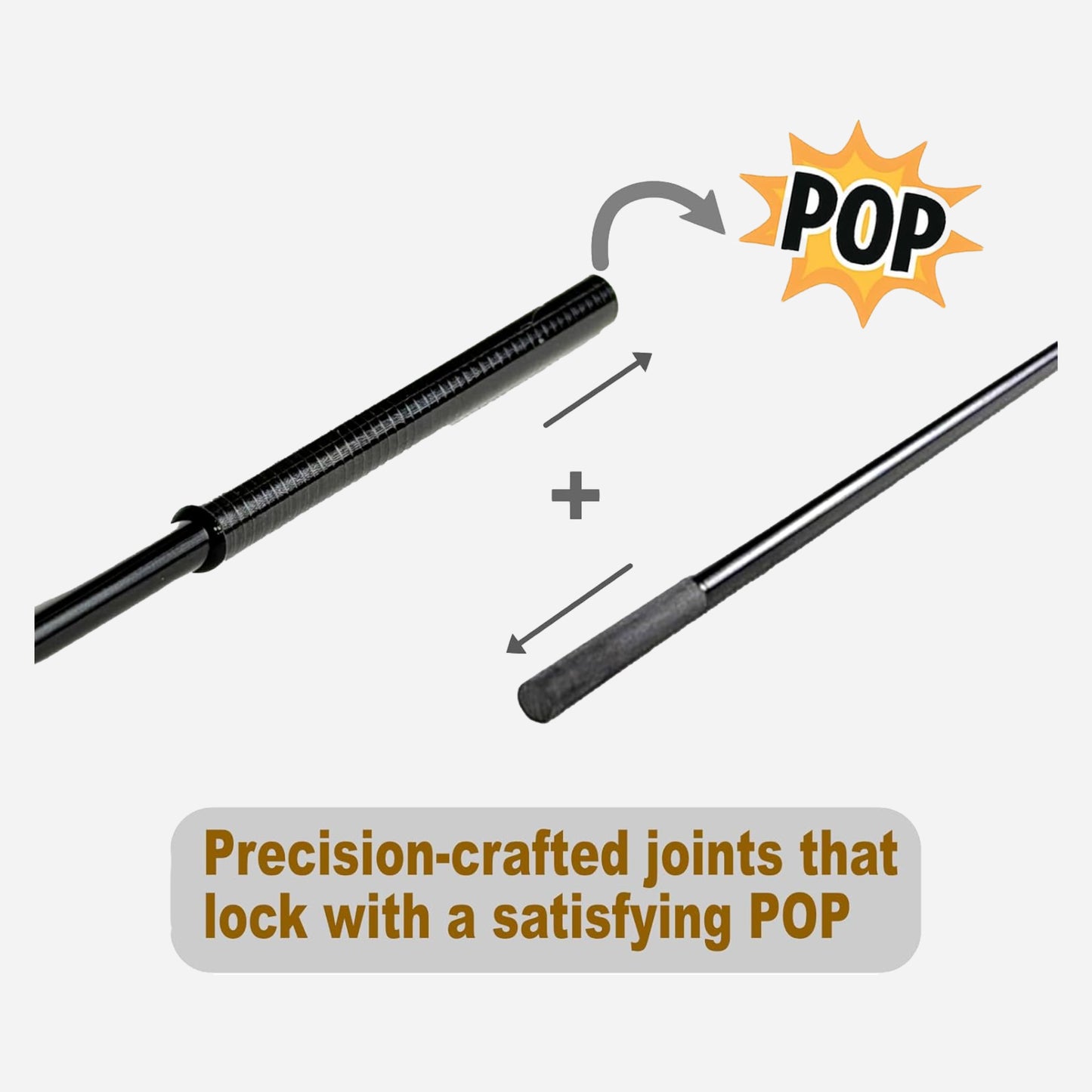
The “pop” sound when separating sections is normal... it’s the vacuum-tight fit releasing.
About This Item
- 5-Section Plug-in Design ... Each carbon fiber section connects precisely with a vacuum-tight fit, creating a secure joint with a satisfying “pop” sound when detached.
- Precision carbon craftsmanship ... Made by specialist carbon manufacturers using hand roll-wrapping and fine hand-sanding for strong, consistent sections.
- Ultra-Light yet durable ... Weighs only 78 g (2.75 oz) while offering excellent elasticity and strength, comparable to high-grade carbon rods.
- Adjustable frequency range ... Connect sections to select the working length for 4 m, 6 m, or 10 m setups.
- Universal compatibility ... Includes 3/8-24 male and 3/8-24 female adapters for custom mounting options.
Mechanical Design
Each section is manufactured for tight, repeatable mating so the assembled whip stays straight and stable in the field. Compared to long, thin stainless whips, carbon sections offer a very favorable stiffness-to-weight ratio... especially helpful when your mount or mast is lightweight.
Electrical Characteristics
This is a length-selectable radiator... you build the whip to the length that best fits the band you want to operate. As with any portable vertical, final resonance depends on the mount, counterpoise/radials, vehicle/body coupling, and nearby objects.
For best results, treat it like a real antenna system... good ground/counterpoise matters more than chasing a “perfect” analyzer screenshot.
Recommended Setup
- 10 m (28 MHz) ... Use the longer configuration and a proper mount with a counterpoise or radials.
- 6 m (50 MHz) ... Use fewer sections to reduce length and bring resonance into band.
- 4 m (70 MHz) ... Shorter configuration, again with a solid counterpoise strategy.
- 5 plug-in carbon fiber whip sections
- 3/8-24 male adapter
- 3/8-24 female adapter
Why Carbon Fiber Here?
For portable work, the practical advantages are straightforward:
- Low weight ... less stress on mounts and lightweight masts.
- High stiffness ... helps keep the radiator straight (and predictable) in wind.
- Modularity ... quick band changes without sliding segments or clamp hardware.
Want the deeper measurement perspective (no myths, no marketing)... see the related reading links above.
Recommended Use Cases
- Portable VHF setups (field days, parks, lightweight mast work)
- Quick deploy / quick pack band-selectable verticals
- Travel kits where size and weight matter
- Experimenters who want a repeatable modular radiator for different builds
Mini-FAQ
- Is it “tunable” by changing sections? ... Yes. Section count changes the physical length, which shifts resonance between 10 m, 6 m, and 4 m style configurations.
- Do I still need radials/counterpoise? ... Yes. Like any vertical radiator, the return path matters a lot for efficiency and stability.
- What does the “pop” sound mean? ... Normal... it’s the vacuum-tight joint releasing when you detach a section.
- Can I leave a joint half-seated? ... No. Always seat each joint fully for mechanical strength and reliable RF contact.
- Will the exact resonance match every setup? ... Not always. Mounting, nearby metal, and counterpoise strategy can shift resonance... measure in your real configuration.
Interested in more technical content? Subscribe for deep-dive RF articles and lab notes.
Share