RF Guru
RX Frontend Protector – Galvanic Isolator & RF Limiter (0.5MHz - 300 MHz)
RX Frontend Protector – Galvanic Isolator & RF Limiter (0.5MHz - 300 MHz)
Couldn't load pickup availability
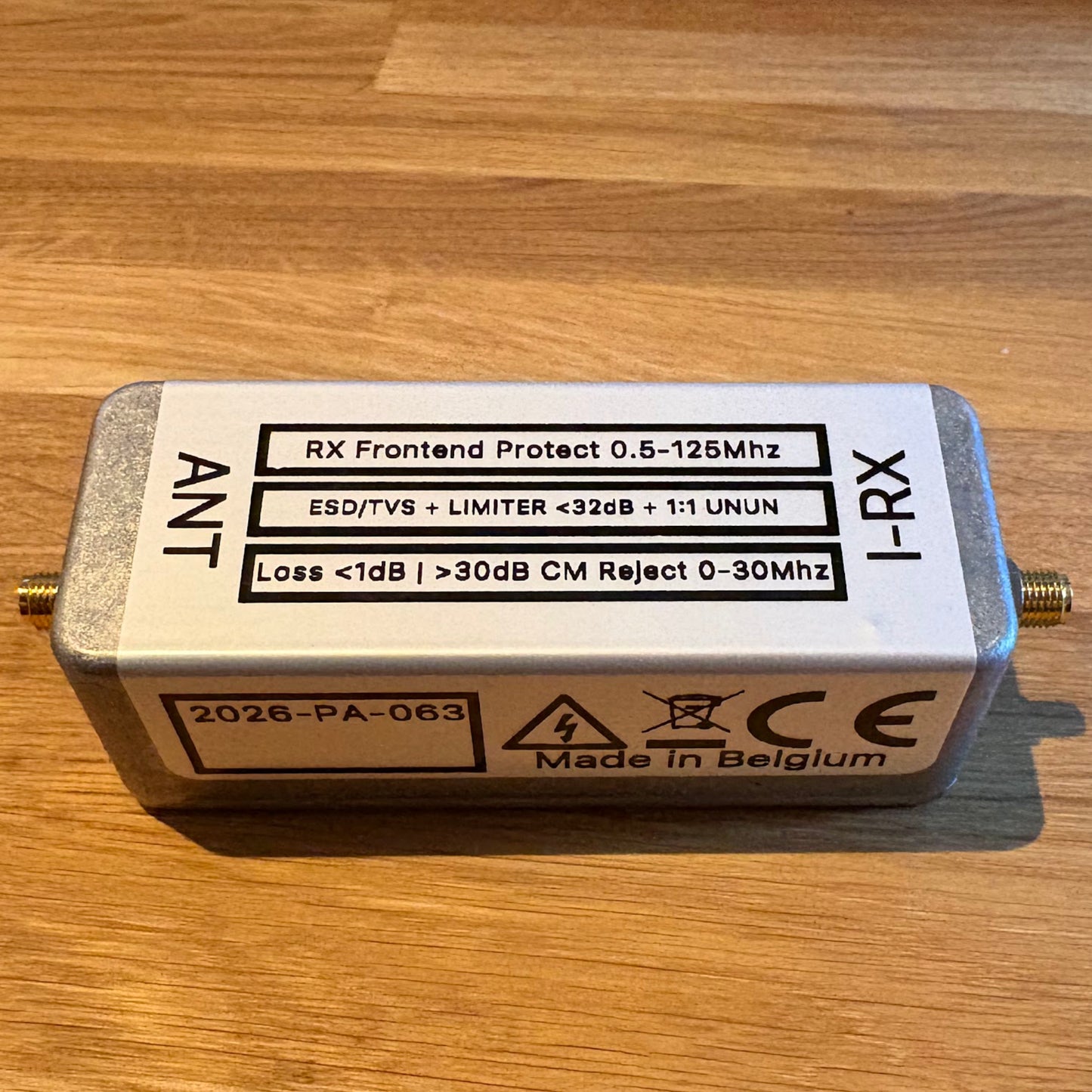
The RX Frontend Protector – Galvanic Isolator & RF Limiter is a passive, wideband in-line protection module designed to safeguard sensitive HF/VHF receiver and SDR front ends against ESD, static buildup, and excessive RF levels caused by nearby transmitters.
Optimized for HF reception (0.5–300 MHz), this module combines multi-stage ESD and surge protection, a wideband MMIC RF limiter, and a 1:1 RF transformer isolator. When installed directly at the receiver input, it helps prevent permanent damage, reduces front-end overload, and improves immunity to common-mode noise pickup.
What This Module Does in Practice
- Protects receiver inputs from ESD, static discharge, and accidental high RF exposure.
- Limits strong RF signals so coupled TX energy is capped to receiver-safe levels.
- Provides galvanic isolation to break ground loops and suppress shield-borne noise.
- Improves receive SNR by reducing common-mode noise that often dominates modern HF installations.
ESD and Static Discharge Protection
The front-end protection network safely diverts fast, high-voltage transients away from the receiver input before they can reach sensitive circuitry:
- Gas discharge tube surge arrestor — conducts high-energy ESD and surge events to ground once its sparkover voltage is exceeded, while remaining effectively invisible to RF during normal operation.
- High-value static bleed path (1.2 MΩ) — prevents charge accumulation on the antenna or coax.
- Low-capacitance ESD clamp array — provides fast secondary clamping for residual ESD energy and sharp voltage spikes.
Outcome: ESD events are dissipated before reaching the limiter stage or receiver input.
RF Limiting for Strong Signal Protection
A wideband MMIC limiter follows the ESD stage and acts as the primary RF amplitude protection element. It is designed to tolerate high incident RF levels caused by near-field coupling from nearby transmit antennas.
- Handles high RF input levels without damage.
- Clamps excessive RF so the receiver is not driven into destructive or severe over-range conditions.
- Design target: up to +32 dBm input limited to ≤ +8 dBm at the output.
The limits stated in the specifications are conservative. In practical testing, the device was exposed to 5 W CW RF input and consistently delivered approximately +8 dBm PEP at the receiver-side output.
Galvanic Isolation and Common-Mode Noise Rejection
A 1:1 RF transformer provides galvanic isolation between antenna-side and receiver-side grounds:
- No DC continuity between antenna and receiver.
- Strong suppression of common-mode currents on coax shields.
- Reduced RF stray pickup entering the receiver chassis.
In real installations, the noise reduction achieved by this isolation typically results in a net SNR improvement that exceeds the small insertion loss of the device.
Recommended Placement
- Install directly at the receiver input for maximum protection and noise reduction.
- Avoid unintentionally bonding antenna-side and receiver-side grounds together.
- Keep isolation intact unless your mechanical design explicitly accounts for it.
Integration Notes
- Impedance: Designed for standard 50 Ω systems.
- DC blocking: No DC pass-through due to the transformer. If using bias-T powered active antennas, inject DC on the antenna side.
- Not a T/R switch: Intended for incidental RF coupling and transient protection only.
Technical Specifications
| Parameter | Specification |
|---|---|
| HF optimization range | 0.5 – 125 MHz |
| Wideband operating range | 1 – 400 MHz |
| Insertion loss | < 1 dB |
| VSWR | < 1.6 |
| Common-mode rejection | ±10 dB on HF, >30 dB on 160 m / 80 m / 40 m (rx 50 ohm) |
| Output limiting level | Max +8 dBm |
| Limiter input handling | Up to +32 dBm (conservative rating) |
Limiter Electrical Specifications (MMIC Stage)
The RF limiter stage is specified in a 50 Ω system. The figures below describe both the linear (weak-signal) region and the limiting (strong-signal protection) region of the limiter device.
| Parameter | Specification |
|---|---|
| System impedance | 50 Ω |
| Frequency range (limiter stage) | 0.5 – 520 MHz |
| Linear range | Max input power for <0.1 dB compression: -10 dBm |
| Insertion loss (linear region) | 0.2 dB typ., 0.7 dB max. (Pin < -10 dBm) |
| VSWR (linear region) | 1.2:1 typ., 1.78:1 max. (Pin < -10 dBm) |
| Limiting input power range | +9 to +32 dBm (filtered signal frequency) |
| Typical limited output power | +7 dBm typ. |
| Δ Output / Δ (1 dB input) | 0.2 dB/dB (9–20 dBm) 0.3 dB/dB (20–25 dBm) 0.3 dB/dB (25–30 dBm) 0.3 dB/dB (30–32 dBm) |
| Recovery time | 3.7 ns typ. (to 90% of final value, 1 W pulse test) |
| Response time | 5.8 ns typ. (-30 to +30 dBm pulse test) |
Note: These are the limiter IC electrical specifications. Overall module performance remains as listed in the main Technical Specifications table above.
S-Parameter Measurements
S11 (Return Loss)

S21 (Insertion Loss)

Live RF Limiting Test
Mini-FAQ
- Will it affect weak signals? — No. Insertion loss is <1 dB, and the limiter only acts on strong RF. In practice, the galvanic isolation and common-mode noise reduction often provide a net SNR improvement compared to a direct connection.
- Is this an active device? — No. It is fully passive and requires no power.
- Can it replace a T/R switch? — No. It is not intended for intentional transmit power.
- Is DC passed through? — No. The transformer provides full DC isolation.
- Where should it be installed? — Directly at the receiver input for best results.