1
/
of
1
RF Guru
Hotspot Ultra-Low-Noise PSU Bundle Ultra
Hotspot Ultra-Low-Noise PSU Bundle Ultra
Regular price
€147,00 EUR
Regular price
Sale price
€147,00 EUR
Unit price
/
per
Tax included.
Couldn't load pickup availability
Handmade in Belgium. Fulfilment times may vary depending on order volume. Please allow 1–2 weeks for assembly and shipping. If you would like a more precise estimate, feel free to contact us before ordering.
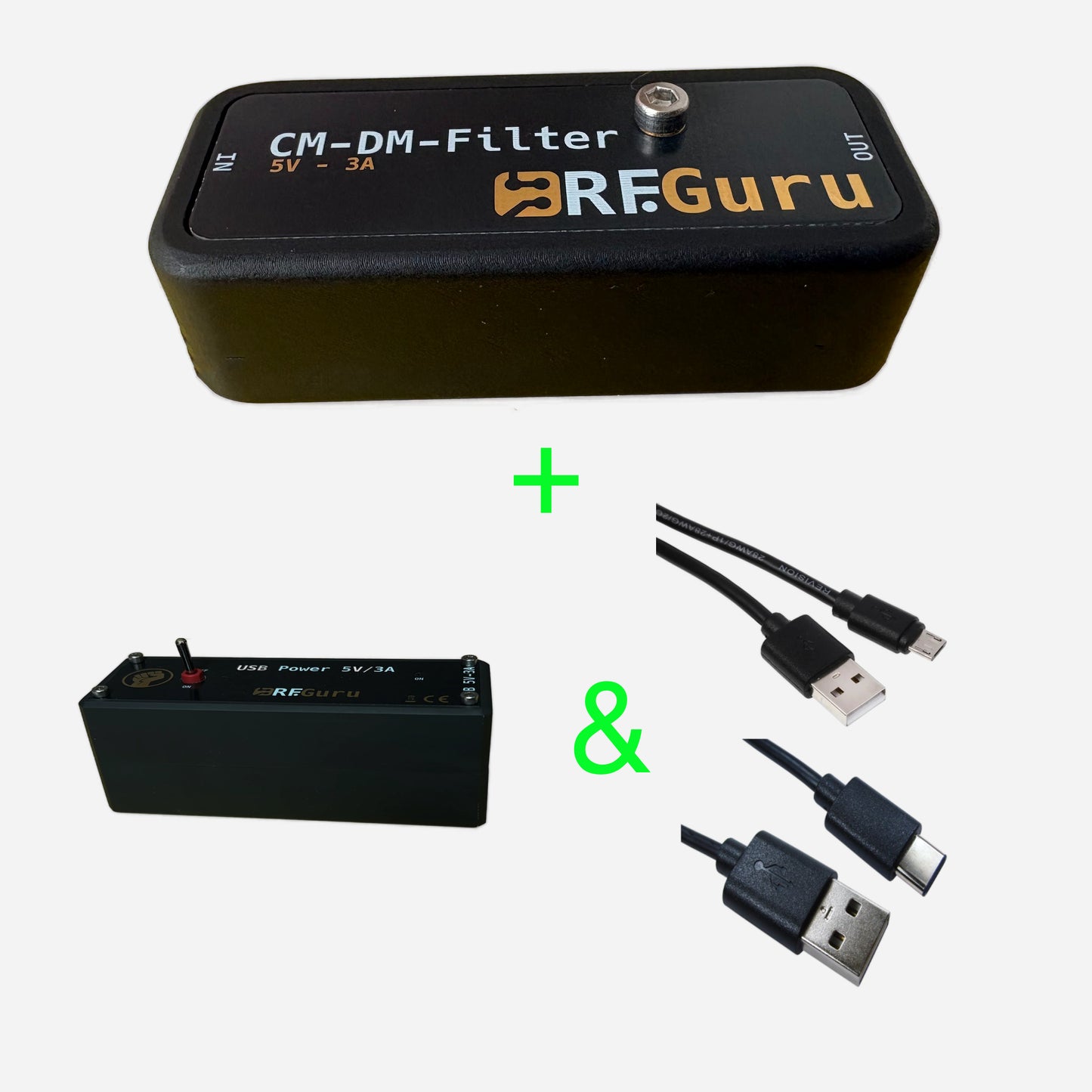
Technical Overview: The Hotspot Ultra-Low-Noise PSU Bundle Ultra is our “maximum quiet” hotspot power bundle for stations where USB power noise is not just annoying, but actually impacts reception. It combines a low-radiating-noise 230 VAC to 5 V / 3 A USB power supply with our inline USB power isolation adapter and the short cables needed to keep the installation tidy and RF-friendly. This bundle is designed specifically for use in the vicinity of SDRs and HF receivers/transceivers, where a noisy USB supply can show up as raised noise floor, spurs, or intermittent “mystery” interference.
(Note: the isolation adapter improves RF/EMI isolation and conducted-noise suppression on the power path; it is not safety-rated galvanic isolation like a transformer-isolated converter.)
Best Hotspot Experience (Lowest Possible Noise):
For the cleanest, most RF-quiet setup, place the USB isolation adapter inline between the ultra-low-noise USB PSU and the hotspot. This extra isolation stage reduces conducted noise and shield/ground coupling, helping you reach the lowest noise floor and the most stable “quiet” RF behavior possible when operating near sensitive receivers.
What’s Included
- Ultra-Low-Noise Isolated USB Power Supply (230 VAC → 5 V / 3 A): optimized for low radiated noise when used near SDRs and HF receivers/transceivers.
- USB-C to USB-A (Female) Ultra-Low-Noise Isolation Adapter: inline EMI isolation and power-path filtering.
- USB-A to USB-C cable (0.5 m): connects the PSU to the isolation adapter cleanly with minimal cable length.
- Short USB-A to micro-USB cable: for connecting the hotspot (device side).
Key Features
- Low-radiating-noise AC→USB PSU: intended for installations next to SDRs and HF receivers/transceivers.
- Inline isolation on the USB power path (EMI): multi-stage filtering targets multiple noise mechanisms, not just one.
- Common-mode + differential suppression: reduces both “between-the-wires” noise and noise riding on both conductors together.
- Transient and ESD resilience: clamps fast spikes before they reach your hotspot or USB load.
- Controlled shield bleed: avoids a fully floating shield while preventing a hard bond that can re-inject noise via loops.
- Short cable strategy: keeps the noisy “antenna-like” cable length minimized, reducing re-radiation and re-coupling.
How to Connect (Recommended)
- Step 1: Plug the 230 VAC → 5 V / 3 A USB PSU into mains.
- Step 2: Use the included 0.5 m USB-A to USB-C cable from the PSU to the upstream side of the isolation stage.
- Step 3: Insert the USB-C to USB-A (Female) isolation adapter inline (placing it close to the PSU is ideal).
- Step 4: Use the included short USB-A to micro-USB cable from the isolation adapter to the hotspot.
(Tip: the closer the isolation stage is to the power source, the less noise can travel on the cable and re-radiate near your receiver.)
How It Works (Isolation Stage Summary)
The isolation adapter uses several isolation “layers” in series. Each layer targets a different noise mechanism, so the combined result is stronger than any single filter stage.
- Input surge clamp + local decoupling: fast transients are clamped and short current spikes are buffered locally.
- High-frequency impedance step: adds attenuation at RF so digital edge energy doesn’t travel down the cable.
- Common-mode suppression on power + return: impedes noise riding on both conductors together (a major wideband RFI path).
- Differential low-pass smoothing: filters ripple and switching artifacts on the 5 V rail.
- Output-side “last barrier” filtering: residual noise is shunted locally at the output instead of being exported to the load.
- Controlled shield bleed network: prevents a floating shield from charging up while avoiding a hard shield-to-ground bond that can form noise loops.
Who Should Choose the PSU Bundle Ultra?
- You run an SDR on the same desk / in the same rack and you want the lowest possible USB power noise.
- You operate HF receivers/transceivers nearby and you want to prevent USB power from becoming a local noise source.
- You troubleshoot weak-signal reception and want to eliminate “USB power” as a variable.
Related Reading
More background on the included low-noise PSU:
• Ultra-Low-Noise Isolated USB Power Supply (230 VAC → 5 V / 3 A)
• Ultra-Low-Noise Isolated USB Power Supply (230 VAC → 5 V / 3 A)
Share