RF Guru
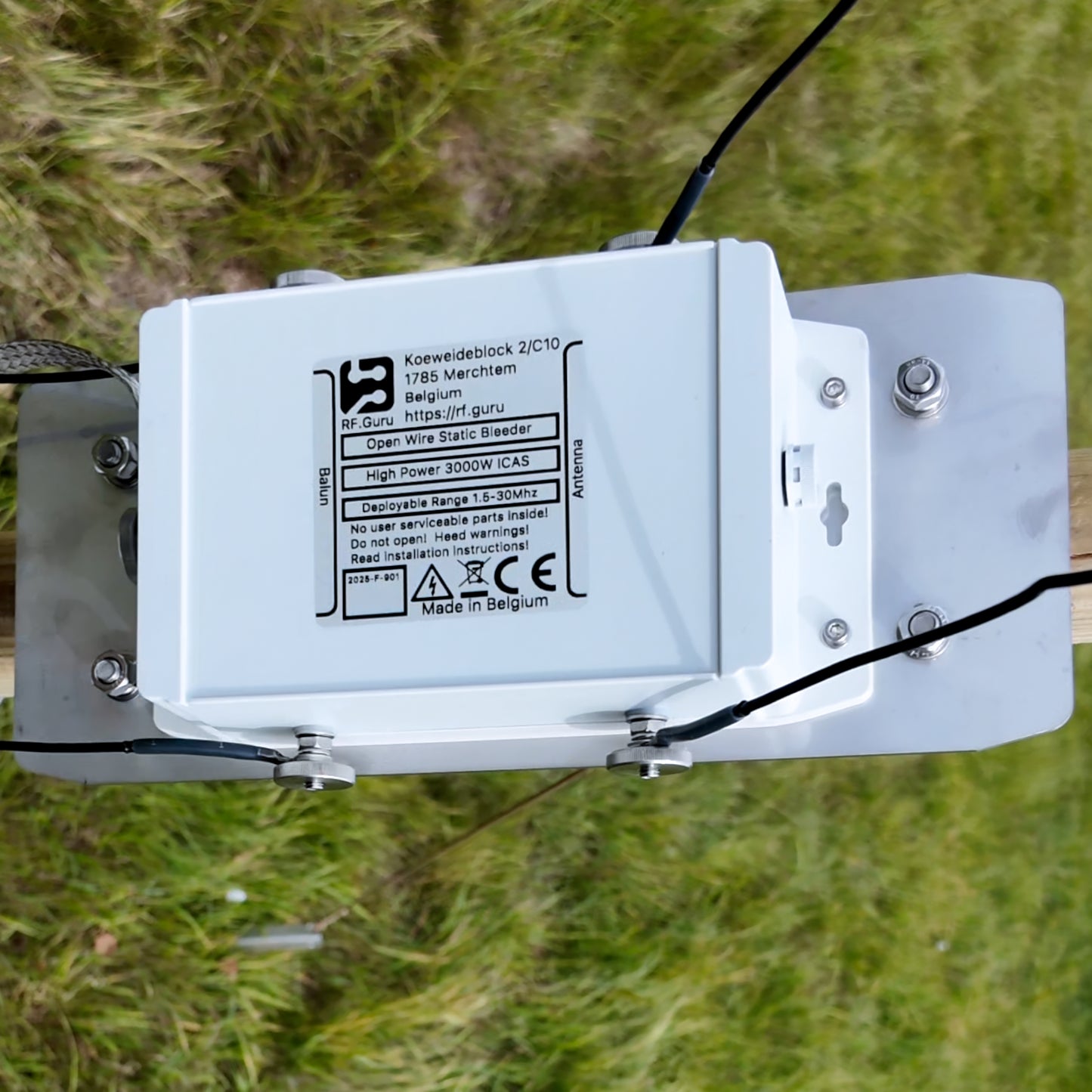
3kW CCS Open-Wire & Coax Bleeder — Protect Your Transceiver
3kW CCS Open-Wire & Coax Bleeder — Protect Your Transceiver
Couldn't load pickup availability
Static buildup is the silent killer of tuners, rigs, and feedlines — especially on antennas that are not DC grounded. That includes doublets and monoband inverted-V antennas, but also ¼-wave verticals with an insulated base, end-fed antennas fed through transformers, and many other installations where the radiator can “float” at DC. Our Open-Wire Bleeder and Coax/Vertical Bleeder provide a controlled DC path to ground plus surge clamping, without becoming a meaningful RF load.
(If your antenna is already DC grounded at the feedpoint — for example a grounded-tower vertical or a deliberate DC short via a matching method — you may not need a bleeder for static, but a proper entrance-panel lightning/surge solution is still recommended.)
Where This Bleeder Is Used
- Open-wire fed doublets (including inverted-V and flat-top variants)
- ¼-wave verticals where the radiator is DC-isolated at the base (insulated base, matching network, capacitive coupling, etc.)
- End-fed antennas where the feed method does not provide a reliable DC path to earth
- Any non-DC grounded antenna that can accumulate charge in wind, dry air, snow, or nearby storm conditions
Key Features
- Handles continuous HF power ≥3 kW from 160–10 m
- Balanced DC bleed (open-wire version): Dual 1 MΩ / 10 W resistors — one per leg for symmetrical static drain
- Unbalanced DC bleed (coax/vertical version): High-value DC path from radiator (“hot”) to shield/ground (radial plate / earth)
- Resistor rating: 12 kV each → 24 kV headroom systemwide
- GDT (2.7 kV, 5 kA) for lightning and surge clamping
- 6.8 nF / 6 kV capacitor for transient control
- High-voltage anti-creepage design: PTFE wire, PTFE spacers, HV coating & gaskets
- Available in open-wire or coaxial versions (PL or N connectors)
Performance
The bleeder network is designed to be RF-transparent across 160 m to 10 m, while still providing a solid DC discharge path for static. In normal HF operation, the limiting factors are the 2.7 kV GDT threshold and the 6 kV capacitor rating, both far beyond what a correctly installed HF station produces under typical operating conditions (including moderate mismatch).
Mini-FAQ
- Does it affect my SWR? — No, the bleeder is designed to be RF-transparent from 160–10 m when installed as intended.
- Can I use this on a ¼-wave vertical? — Yes, on any non-DC grounded vertical: install it at the base so the radiator has a controlled DC path to the radial plate/earth.
- Can I run QRO? — Yes, tested at ≥3 kW continuous HF with large voltage margin.
- Do I still need a lightning arrestor? — Yes. The bleeder drains static and helps clamp surges, but it’s not a substitute for a proper lightning/surge system at the shack entrance.
Interested in more technical content? Subscribe to our updates for deep-dive RF articles and lab notes.
Questions or experiences to share? Contact RF.Guru here.
Share