

RF Guru
10kW CCS Dual Core 1:1 Antenna Tuner Current Balun Coax <-> Open Wire
10kW CCS Dual Core 1:1 Antenna Tuner Current Balun Coax <-> Open Wire
Couldn't load pickup availability
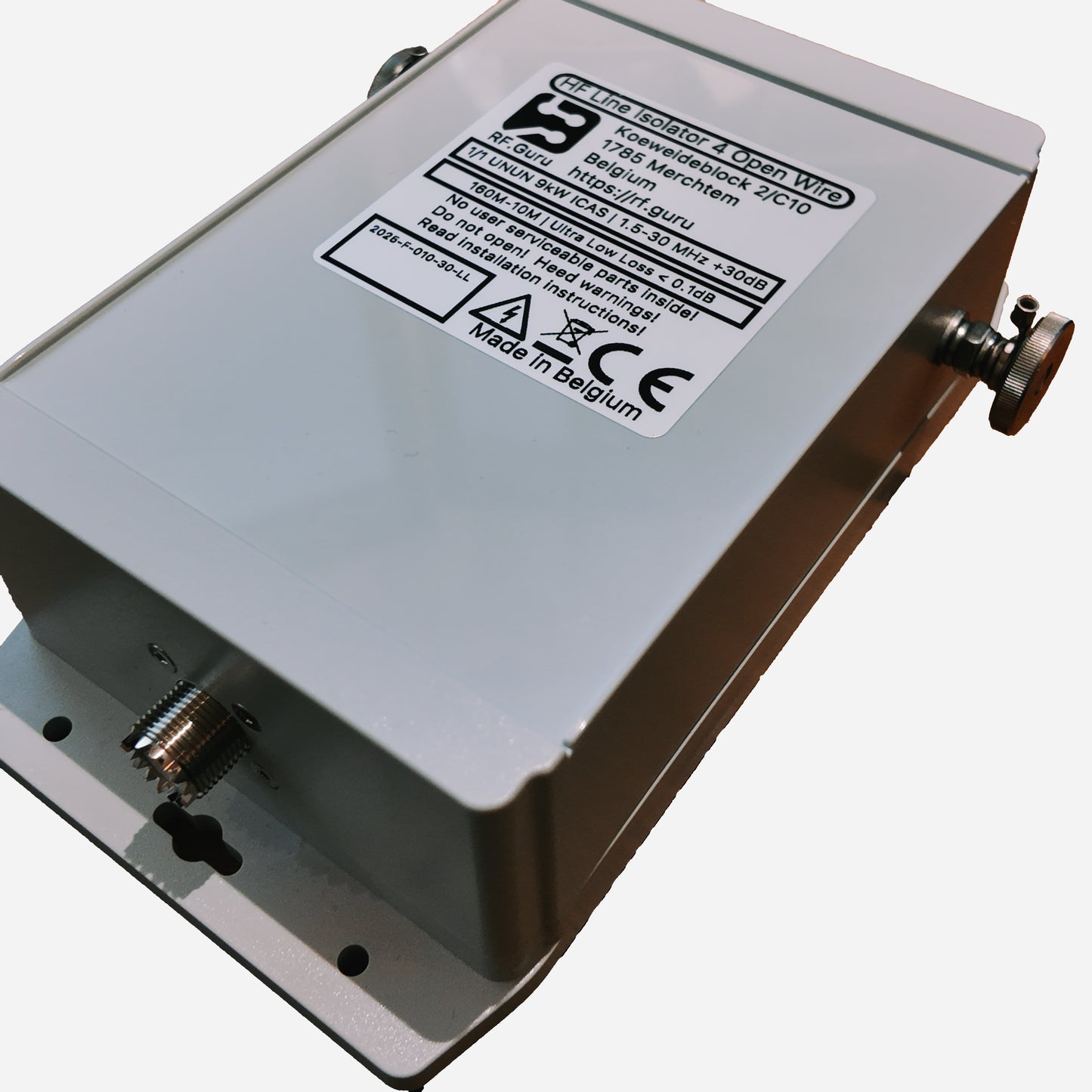
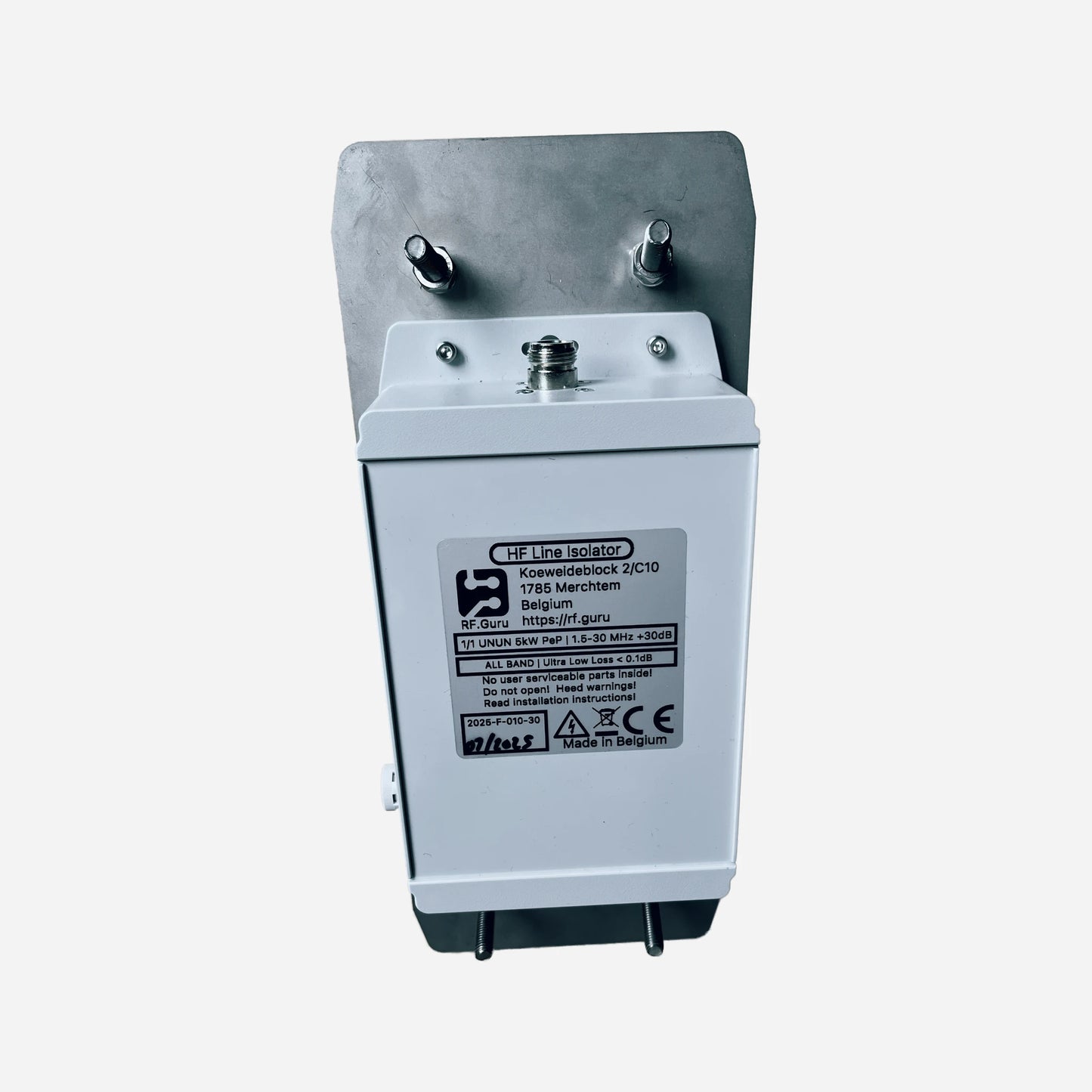
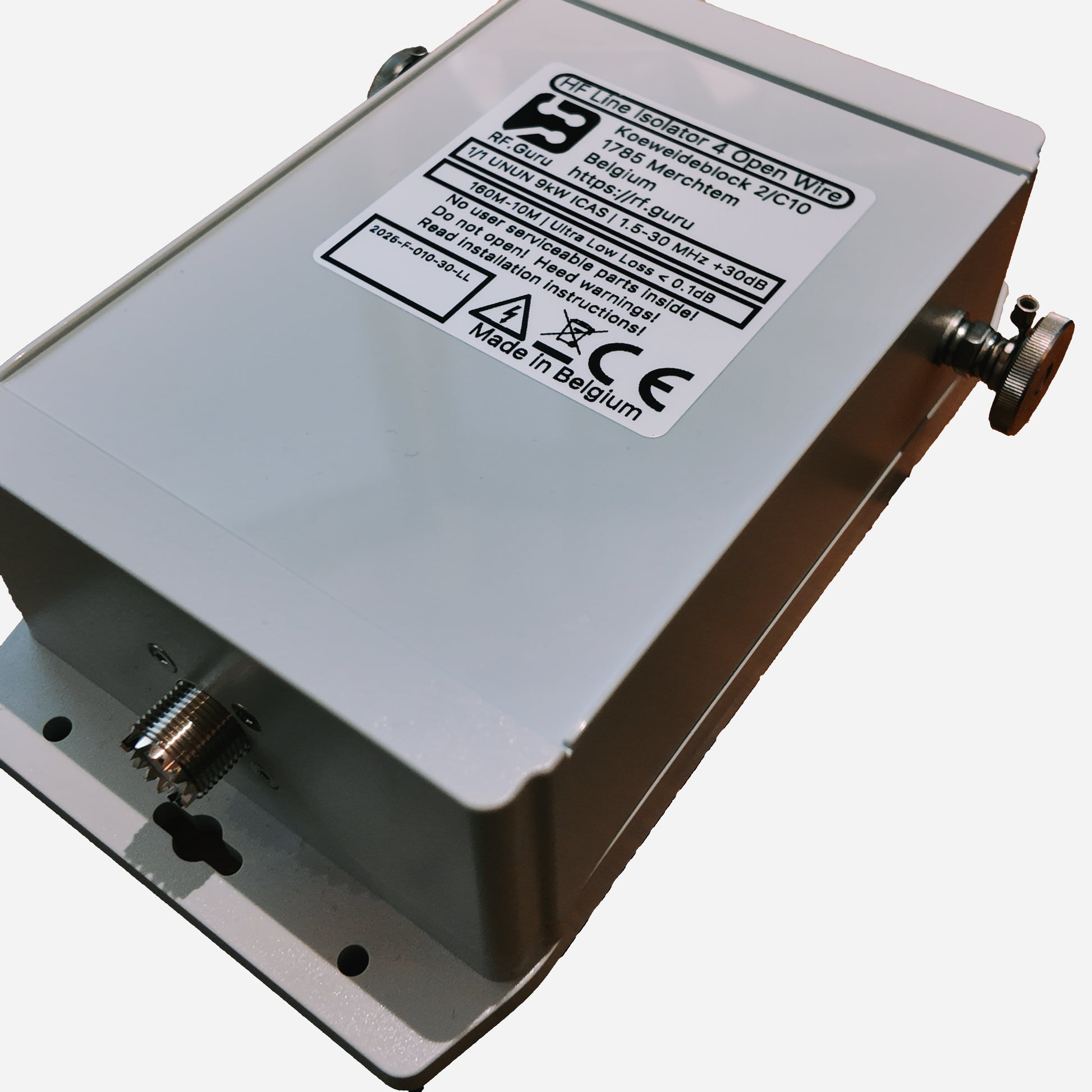
The 10 kW CCS Dual-Core 1:1 Antenna Tuner Current Balun (Coax ↔ Open Wire) provides a robust and symmetric transition from unbalanced coax to balanced ladder-line or open-wire systems. It ensures true current balance, prevents RF feedback, and maintains high CM rejection even under extreme mismatch voltages. Built around two stacked 4″ toroids and a Teflon bifilar twin-lead winding, it offers amplifier-grade performance at legal-limit power.
Correct Use of RF.Guru Antenna Tuner Baluns
Baluns in a Nutshell
How Much Choking Do You Really Need — for RX and TX?
Balanced Feed Transition for Tuners
Includes a single coaxial input (PL-259 or N-type) and two M6 INOX terminals for ladder-line output. Each terminal uses Teflon insulation for extreme HV creepage margin — essential for tuner-fed systems with high SWR.
Why Bifilar Windings?
The Teflon twin-lead winding provides:
- Excellent differential-mode balance
- High voltage standoff due to Teflon spacing + sleeving
- Low inter-winding capacitance under mismatch
- Predictable |ZCM| even with severe SWR
Although not coaxial, the balun develops a high, real common-mode impedance. The numbers below are from true CM measurements — not differential S-parameters.
Specifications
- Cores: 2 × 4″ ferrite toroids
- Winding: 11 turns Teflon twin-lead (24 kV/mm)
- Input: PL-259 or N-type
- Output: 2 × M6 INOX terminals with Teflon spacers
- Enclosure: HV-coated polycarbonate, gasket, pressure valve
- Power rating: 3 kW ICAS / 1.2 kW CCS (single), 10 kW CCS in series
- Frequency: 1.5–30 MHz (usable to 54 MHz)
Measured Performance (Single Unit)
Measured using EMC-standard common-mode injection with calibrated sensing.
| Band | Choking Impedance (Ω) | Impedance-Equivalent dB (from |Zc|) |
|---|---|---|
| 160 m | 12.0 kΩ | 53.6 dB |
| 80 m | 16.0 kΩ | 56.1 dB |
| 40 m | 6.0 kΩ | 47.6 dB |
| 30 m | 2.0 kΩ | 38.1 dB |
| 20 m | 1.6 kΩ | 36.1 dB |
| 17 m | 1.4 kΩ | 35.0 dB |
| 15 m | 1.2 kΩ | 33.6 dB |
| 12 m | 1.0 kΩ | 32.0 dB |
| 10 m | 0.8 kΩ | 30.1 dB |
| *Impedance-Equivalent (dB) values are computed directly from |ZCM| using a 50 Ω common-mode source reference. They represent the balun’s intrinsic suppression capability — not the CM impedance of a real ladder-line antenna system. More details: Why dB Attenuation Specs on Ham Chokes Are a Mess.* | ||
Add a 10kW antenna tuner balun in series to double ZCM and increase intrinsic suppression by ≈ +6 dB. This is mainly for thermal and magnetic headroom, not for dB stacking.
Maximum ICAS/CCS Power Ratings
| Connector Type | 160–40 m | 30–10 m | 6–2 m | Limiting Factor |
|---|---|---|---|---|
| PL-259 / UHF | ≈2.7 kW ICAS | ≈1.3 kW | ≈0.6 kW | Connector |
| N-type | ≈10 kW ICAS | ≈5 kW | ≈2 kW | Coax |
| 7/16 DIN | ≈10 kW CCS* | ≈5 kW | ≈2 kW | Coax |
*Full 10 kW CCS requires adding a 10kW antenna tuner baluns in series (or a 10kW choke in front) with ≈2 m spacing. This shares thermal and magnetic load; dB does not add linearly.
Mechanical Highlights
- Dual 4″ stacked cores
- Teflon twin-lead winding (24 kV/mm)
- M6 INOX terminals with Teflon isolation
- IP64 UV-resistant polycarbonate housing
- Approx. 700 g
All RF.Guru baluns are measured using EMC-standard dual-probe CM testing. One probe injects controlled common-mode current; the other measures residual CM current.
This yields true Common-Mode Rejection (CMR) — actual CM current reduction — not differential-mode artifacts from VNA sweeps.
Differential VNAs excite the coax in differential mode. Our EMC method measures true CM suppression under load, exactly as seen in tuner-fed systems.
Mini-FAQ
-
Q: Can I connect it directly to my tuner?
— Yes. Coax in → tuner; M6 terminals → ladder line. -
Q: Why bifilar winding?
— It maximizes HV tolerance, balance, and stability under mismatch. -
Q: Do two units double the dB?
— No. They add ≈ +6 dB and greatly improve thermal headroom. -
Q: Outdoor safe?
— Yes. Fully sealed IP64 enclosure. -
Q: Power rating?
— 3 kW ICAS / 1.2 kW CCS per unit; 10 kW CCS with two in series.
Interested in more technical content? Subscribe to our updates.
Questions or experiences to share? Contact RF.Guru.
Share