RF Guru
RF.Guru 15 cm HAREC Bench Ruler
RF.Guru 15 cm HAREC Bench Ruler
Couldn't load pickup availability
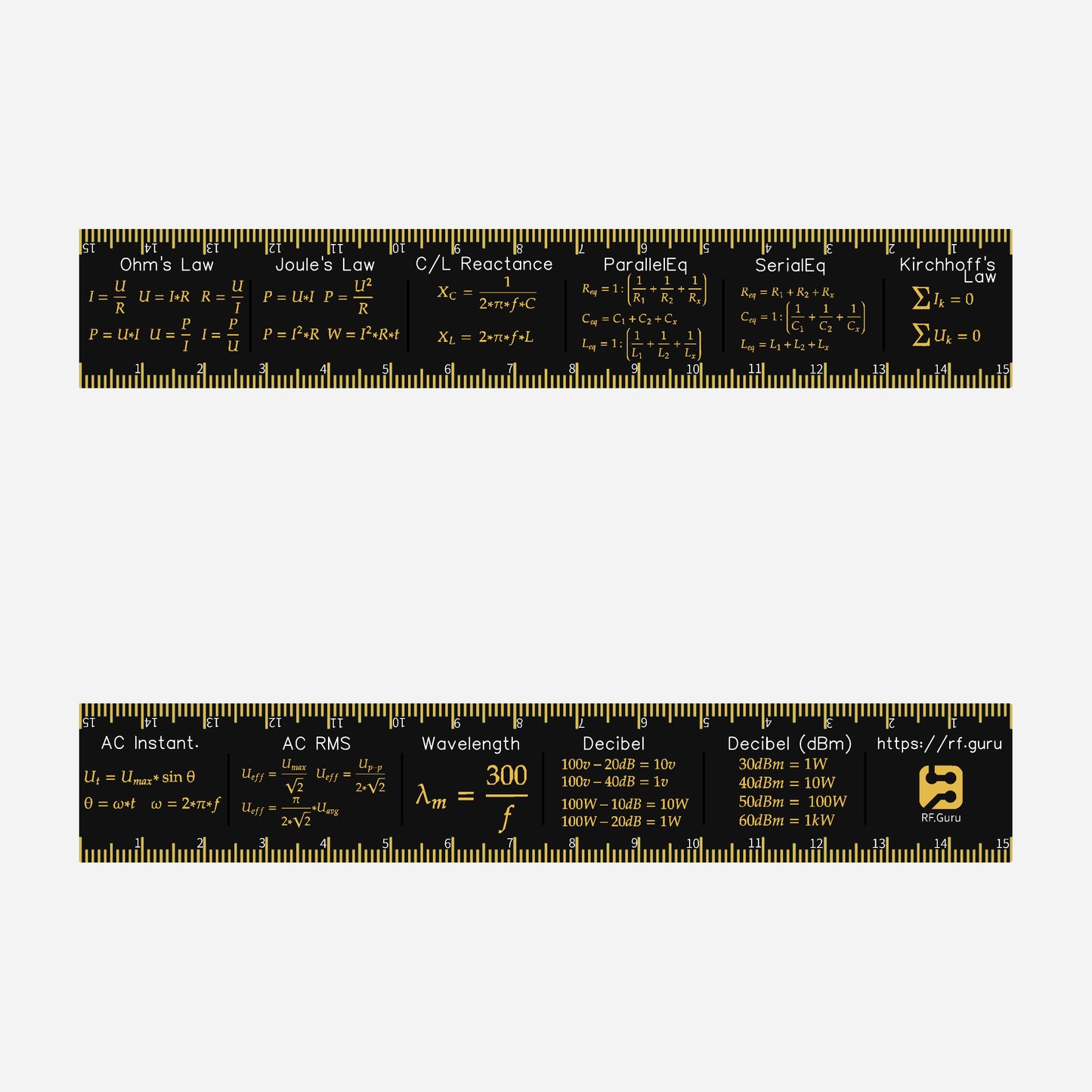
The RF.Guru 15 cm HAREC Bench Ruler is a compact study and bench reference tool made for radio amateurs, electronics students, makers, and HAREC exam candidates. It combines a practical 15 cm ruler with the core formulas that repeatedly come back in radio and electronics theory: Ohm’s law, power, reactance, series and parallel equivalents, Kirchhoff’s laws, AC formulas, wavelength, decibels, and dBm conversion references.
What It Is
This 15 cm ruler is designed as both a measuring tool and a quick-reference study aid. On one side, it carries the most important DC and circuit formulas. On the other, it covers AC, RMS, wavelength, and decibel references that are especially useful in amateur radio theory and HAREC-style study sessions.
Why It Matters for HAREC Study
HAREC exam preparation is not only about memorizing isolated formulas. It is about recognizing which relationship applies to a problem, rearranging it correctly, and understanding what the result means in a practical radio or electronics context. The formulas on this ruler cover many of the exact building blocks that appear again and again in study material and calculation exercises.
- Need to find current from voltage and resistance? That is Ohm’s law.
- Need to estimate heating or power in a resistor? That is Joule’s law and power relationships.
- Need to understand why capacitors and inductors behave differently as frequency changes? That is reactance.
- Need to reduce a network of parts to one equivalent value? That is series and parallel calculation.
- Need to solve a simple circuit with branches and loops? That is where Kirchhoff’s laws come in.
- Need to convert power ratios or absolute power levels? That is where dB and dBm show up.
- Need to estimate wavelength from frequency? That is one of the most common radio exam shortcuts.
Formula Groups Included
Ohm’s Law
This is the foundation of basic electrical calculation. It links voltage, current, and resistance. In practice, it lets you calculate how much current flows, what resistance is needed, or what voltage will appear across a component. For HAREC study, this is one of the most frequently used relationships because many more advanced questions still rely on this first step.
Joule’s Law and Power Formulas
These formulas show how electrical power relates to voltage, current, and resistance. They are essential when dealing with resistor dissipation, supply loading, and practical circuit safety. In exam terms, these formulas often appear in questions about heat, efficiency, resistor ratings, or how much power is consumed in a given circuit.
Capacitive and Inductive Reactance
Reactance explains why capacitors and inductors oppose AC differently depending on frequency. A capacitor’s reactance falls as frequency rises, while an inductor’s reactance rises with frequency. This matters directly in RF and HAREC study because it helps explain tuning, filtering, resonance, coupling, bypassing, and why the same component behaves differently at audio, HF, and VHF.
Series and Parallel Equivalents
These relationships help you combine multiple resistors, capacitors, or inductors into one equivalent value. That is useful in both circuit design and exam problems. It teaches you to simplify a network so the rest of the calculation becomes easier. This is especially helpful when working through basic schematic problems or component combinations.
Kirchhoff’s Laws
Kirchhoff’s current law and voltage law are central for understanding branches and loops in a circuit. One says current is conserved at a node. The other says the sum of voltages around a closed loop equals zero. These rules matter because they give you a structured way to solve circuits instead of guessing. In theory questions, they are the backbone behind many step-by-step network calculations.
AC Instantaneous and RMS Formulas
AC is not just “voltage that changes.” The formulas on the ruler remind you how sinusoidal voltage is described over time and how RMS relates to peak and peak-to-peak values. RMS is particularly important because it is the effective value used in real power calculations and in most practical test equipment readings.
Wavelength Formula
The wavelength shortcut printed on the ruler is one of the most useful formulas in amateur radio. It lets you estimate wavelength directly from frequency, which is valuable when thinking about antennas, element lengths, quarter-wave sections, and resonant structures. For HAREC candidates, this formula is one of the most practical ones to keep instantly available.
Decibel and dBm Reference
Decibels are everywhere in radio: gain, loss, filters, feedlines, amplifiers, and signal chains. The ruler includes quick dB and dBm references to make the logarithmic system easier to use in practice. dB expresses ratios. dBm expresses absolute power referenced to 1 milliwatt. These are common stumbling blocks for students, so having the most-used conversions visible can save time and reduce mistakes.
Specs at a Glance
| Feature | Details |
|---|---|
| Length Scale | 0 to 15 cm metric ruler |
| Primary Use | Bench ruler and HAREC-style theory reference tool |
| Reference Topics | Ohm’s law, power formulas, reactance, series and parallel equivalents, Kirchhoff’s laws, AC, RMS, wavelength, dB, and dBm |
| Format | Compact flat bench and study accessory |
| Best For | Amateur radio students, HAREC candidates, makers, and electronics bench users |
| Branding | RF.Guru design with dual-side printed reference content |
Where It Fits Best
- Next to your notebook during HAREC study sessions
- On the electronics bench for quick measurement and theory checks
- In a field kit, toolbox, or backpack for portable reference
- As a practical gift for hams, students, and makers
- As a compact add-on item for technically minded RF.Guru customers
Care and Handling
- Wipe clean with a soft cloth
- Avoid aggressive solvents or abrasive cleaners
- Store flat to help preserve the surface markings and straight edges
Mini-FAQ
- Is this mainly a ruler or a study tool? Both ... it is a practical 15 cm ruler with core electronics and radio formulas printed on it for everyday reference.
- Is it useful for HAREC exam study? Yes ... it covers many of the core relationships that commonly appear in amateur radio and HAREC-style theory study.
- Does it replace proper course material? No ... it works best as a fast reference and memory aid alongside notes, books, and practice questions.
- Who is it for? Amateur radio students, exam candidates, electronics hobbyists, makers, and anyone who wants the key formulas visible on the bench.
Interested in more technical content? Subscribe to our updates for deep-dive RF articles and lab notes.
Questions or experiences to share? Feel free to contact RF.Guru.
Share